Formerly,Bar None Ranch, of Berlin, NY, we are now Climbing Tree Farm, of New Lebanon. We raise PASTURED POULTRY, LAMB, GRASS-FED BEEF, and WOODLAND/PASTURE-RAISED, MILK-FED PORK. We keep our animals true to their instincts- letting our pigs dig, our chickens range, our sheep graze. We feed rotationally graze on pasture and silvo-pasture (in the woods). We work with a local dairy to feed our pigs Jersey milk. We are conscientious stewards of the land, and our animals.


Please visit our website climbingtreefarm.com
or contact us with questions or to place orders.


Showing posts with label Nature on the Farm. Show all posts

Monday, April 27, 2015

Life and Death (warning: graphic photos of chicken slaughter + pictures of adoreable newborn calf)

For the last several months we have been helping students at a local boarding school, Darrow, to prepare for and raise chickens for a project that they are working on- in which they hope to create a McDonald's-like "Happy Meal" with sustainable materials. Last Wednesday was slaughter day. We've been curious to see how the students would react to killing and cleaning the chickens they helped to raise from newly hatched chicks. These kids are awesome! They handled the chickens' death with dignity, kindness and purpose.
 
A group of students came to our house to pack the chickens up and take them to the school for slaughter. We talked about how that moment, when you choose to take the animal off pasture and to turn a living being into food, is a privilege, and something that should be done with ceremony, respect and gratitude. It felt  good to see these chickens help teach these lessons. I was proud of the students, who we have been working with for the last five or so months- they have a lot left to learn (about farming, and life, and all the millions of things we all have left to learn), but this they did really well.
 
During the slaughter I re-fielded a question I often get "why doesn't it bother you when your animals are slaughtered?" It does. Its sad every time. These are living things (some of whom are extremely cute and/or animals that we have become close with) and we choose to kill them. When killing animals (that we care about) becomes nonchalant and fails to stir our emotions- then we will know that we need to stop raising animals for meat. We respect our animals in life and we are thankful for them in death.


Generally at the end of slaughter you are left with a bucket of intestines, other unpalatable organs,
and heads. This slaughter was different- the biology teacher who helped with this project gave a
running commentary of every organ and how it worked. She even found a chicken heart with fluid
and explained that the chicken might have been experiencing heart failure.This is what teenagers do
 with chicken heads...they discussed putting them on strings or sticks to use them as puppets for
 performance art. Love to see every piece of these chickens used and appreciated.

Standing!

While the cow labored some of the herd looks on.
After slaughter with the high-schoolers, our kids and I stopped by our friend Cynthia's farm. She had had two heifer (girl) calves born that morning, and when we arrived we learned that a third calf was on it's way. We watched from the car in the pouring rain with Cynthia as one of her Randall Cattle gave birth.  The cow grazed the fresh spring grass as she labored, occasionally arching her back or laying down to resituate the calf inside. We watched for about a half an hour before a bull calf was born into the pouring rain. The mother licked and cleaned the baby and the calf was up and walking (on wobbly legs) about a half an hour later. Birth, like death, is something that people don't see very often these days, in this culture. In a world so divorced from life and death, I feel lucky to see the almost magical segue between alive and dead, sometimes all in one day, and to feel my heart stir. It reminds me that I am alive.
 
That night four Great Blue Herons flew over our house in a perfect line. Somehow that felt important, but I'm not sure how. 


Sunday, March 8, 2015

Wintery Piglets


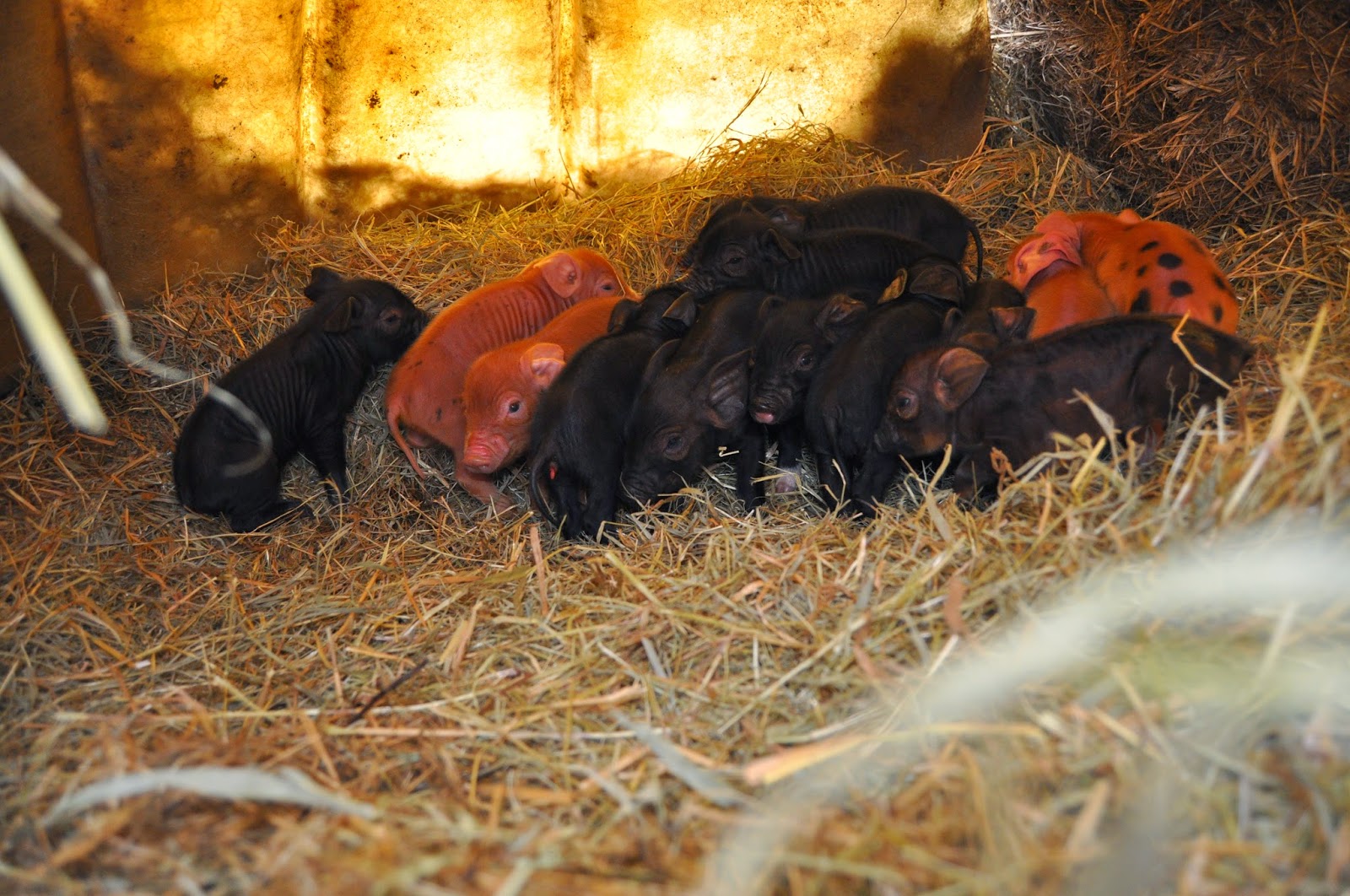
Piglets! Tina gave birth to 15 piglets March 3rd. They were born outside on a 0 degree night onto a bed of hay (in a sea of snow) that they shared with their mother, father and grandmother. The piglets came sooner than expected, and would normally have had snugger accommodations (like the hut they are in in these pictures), but have done remarkably well.


Sunday, February 22, 2015

Cold and Sparkly

It's been cold enough and snowy enough to make our lives
extremely difficult this last month or so,
 but damn is it beautiful. I have never seen it so sparkly.

Thursday, October 16, 2014

Fertilized Oak


Guess which acorn grew on a tree that was fertilized by pig manure last year?

The giant acorn fell from a tiny Red Oak tree in a spot that the pigs grazed in last year.
The average sized acorn fell from a mature Red Oak that was not fertilized.

Never doubt the power of poo (and animal impact)!


P.S. - This is not an isolated incident- all of the Oaks that the pigs foraged around
 last year gave abnormally large acorns.

Monday, October 6, 2014

It's Nut Season!

Hickory nuts

Acorns
This is a fabulous nut year. Have you noticed? We've been slipping on them there are so many! This is great news for the pigs, who LOVE to eat nuts. Have you tried acorns or other fresh nuts? Yuck- they must be an acquired taste! The pigs effortlessly crack through the tough shells, and gorge on the bitter meats of hickory, acorns, walnuts, butternuts, and beech nuts. At this time of year they turn their noses up at grain, and focus their attention on vacuuming nuts off the ground. A nut-rich diet helps to give our pigs their unique flavor and fine marbling.

Thursday, April 3, 2014

Sheepy Sign of Spring!

Grey sky. Snow patches. Brown grass.
 It may not look like much, but this here is one of the first signs of spring!
The sheep are spread out across the field grazing,
rather than bunched up around a round bale (of hay).

Today I was remembering an early spring trip to California a few years ago-
 It was grey and muddy here in New York.
We arrived in California in the dark and the next morning
we were shocked to see the long, vibrant Spring grass.
We were so starved for green that we got out of our rental car
and we all rolled around in the beautiful green on the side of the road.
 At the time the fresh, spring grass looked to alive we just wanted to eat it!
(It's possible that we tasted it- not sure.)
Alas, the mud is here for a while, and the seasons change slowly.
But....The earth is awakening. The sheep have forecast it: Spring is coming!

Mulefoot Babies


We've been looking for years for a Mulefoot Boar to breed,
 and haven't been able to find a fella for the job.
We generally have a fairly closed herd (we raise most of our own stock),
 but recently brought in two Registered Mulefoot gilts and boars. This year we bred our
 Mulefoot gilts to a Red Wattle, and while we expect beautiful animals out of that breeding,
we are excited to be able to breed our own pure Mulefoot hogs,
 in part because that will help to preserve such a rare heritage breed.

Livestock farming is all about long-range planning.
 Conventional hog farms raise a pig to size (from birth to 200 lbs.) in 5 months.
Most of our heritage breeds grow to size in 9-10 months.
Mulefoot grow more slowly- with an average age at slaughter (on our farm) of a year or more.

These little guys will have piglets next spring (2015)
and those piglets will be ready for harvest in the spring of 2016.


The four amigos- Here they are housed in a training pen.
You can't tell from the picture, but these piglets are about the size of house cats.
They're a little small to be reliable in electric fencing, and will be trained to electric in this pen.
 (Pen is outdoors and about 16x64 feet, for the four piglets).


Chicks- for pleasure and meat...


After many years of brooding chicks in our basement (which is smelly, dusty and cumbersome),
we now have a chick brooding shed. the back third of the shed is sectioned off for brooding, with 50 gallon drums split lengthwise, strung with heat lamps, and used as a heat hood. It has been quite a bit colder out than we expected so far this brooding season, but we have been able to keep the little guys warm with extra heat lamps and rigid insulation piled on top of the brooder. In their first weeks chicks require a temperature of around 90 degrees (think- snuggling up under mother-hen's tail feathers). As their fluffy down falls out and is replaced by feathers chicks become more all-weather animals. Their first day in the shed it was about 22 degrees outside. We were worried that the brooder wouldn't be warm enough and the first day we visited the chicks every hour. After several trips to the shed Colby had the brilliant idea to put the remote sensor for our thermometer in the brooder- so we can now monitor the brooder temperature without putting our boots on and slogging around in the mud!

Washed up all of the chick feeders and waterers- made a resolution to wash them
 (outside with the hose) at the end of this chick season so that in the spring of 2015
 I do not need to scrub chicken poop off of them in my bathtub again...ever.

Picking up chicks from the post office. This box contains 100 little peeping fuzzballs.

Our son asked for chicks for his 7th birthday. He chose Cochins. They grow to be big, fluffy, and are quite tame. He likes that they have feathered legs and feet.
Here he is at the post office, meeting his new friends.

Opening Birthday present chicks:
 25 Cochins (egg layers) to keep and play with.
75 meat birds to slaughter and sell.
(And, to keep the birthday chicks warm on their journey to our house).
For the past several years we have had between 300 and 500 layers.  We've decided that egg
production is not a viable part of our business, so we will no longer be selling them. It's felt weird
buying eggs from our friends' farm,  rather than out from under our chickens. These little ladies will
 provide our family with eggs in about 22 weeks. And,  our son is thinking about starting his own egg
business. Stay tuned for details.
When we get new animals we always discuss with our kids which animals are for meat,
and which will stick around as pets or breeders. This way they know who to get attached to.
These chicks are pets!


Building a fort for, and reading to the new chicks.

Chicks love stories.

Baby cochins.

Sleepy chick!

The birthday chicks live in the brooder in the shed with the other chicks,
 but come out for visits and story time.

Monday, March 10, 2014

Thursday, September 5, 2013

Life's a Beach for Our Pigs


Our leased land includes a large field that was cleared for building a jumbo house, and then the project was canceled, leaving acres of exposed shale. We call this area of our farm the "Shale Field." One of our goals on the farm is to use our animals to improve the health of the land we work- especially the Shale Field. When we moved to our new farm we put in a septic field, which left a large shale patch in the middle of our pasture. Through grazing, winter feeding (think manure and wasted hay), and spreading old hay, we were able to rehabilitate the area quickly and without adding seed (the seed in the hay fell out and volunteered in the new dirt that was created as the hay decomposed). We're hoping to do something similar on the Shale Field...except on a much, MUCH larger scale.
 
At any rate, we have had a bunch of thunderstorms lately and the Shale Field has turned into Shale Lake (a field of rock is not nearly as porous or absorbant as a field with vegetation!). My guess is that the lake is a couple of acres square and about ten inches deep.
 
During our last storm a tree fell on the pig fence abutting the new Shale Lake. As you might expect, some of the pigs went exploring. They didn't go far, and our pigs are rediculously easy to put back in their fence (a few apples and some milk and they were happily back in the fence in less than a minute). My sense is that pigs who live well don't feel as compelled to travel as those who live in mud, eating who knows what. It also helps that they're smitten with Colby.
 
It's hard to leave our farm, even leaving for the afternoon is a challenge most of the time. There are a lot of creatures depending upon us, and things rarely go as planned. On Monday, when the pigs were out, we were supposed to be at a pig roast (Our pig! YUM!). The pigs who were out were so content splashing in Shale Lake, rolling in the sand pile (not sure why, but there's a dump load of white play sand in the center of the field), and chasing apples that Colby was throwing for them that we just had to stay and play...and be a little late to the pig roast.
 
Honestly, being a farmer is a lot of hard work for little pay, but an afternoon like this, makes it worth it. Our kids were shrieking with joy, our animals were splashing and playing with our children, and we felt good about the way we do our job...even if we're always late to BBQs.
First pig ride.
 
A lake with a view.
 
 
Headed to the beach for a swim.
 
 
ZOOM!

Running around having a blast!

Just a guy and his hogs.

Splashing.

Sand Castles anyone?
 
Scratching in the sand.

Rolling in sand.

Our son wants to take them to the beach next time...
reasoning that we wouldn't have to find anyone to farm sit.

First time digging sand.

Playing with friends.


Sunday, November 18, 2012

Wishing on Porcupines


One of our neighbors.

I recently read this:

“Wish on everything. Pink cars are good, especially old ones. And stars of course, first stars and shooting stars. Planes will do if they are the first light in the sky and look like stars. Wish in tunnels, holding your breath and lifting your feet off the ground. Birthday candles. Baby teeth.”
― Francesca Lia Block

As a new farm we have a lot of wishes around here. I wonder if you can wish on wiggly pig noses, on frosty grass, or maybe on porcupines in apple trees (all of which we have). I've heard that if you make your wishes public it sometimes helps them come true (except in cases involving birthday candles and shooting stars). On the off chance that the universe will hear our wishes and respond, here's our wish list:


Climbing Tree Farm Wishes For:

  • A few steady pig clients. We have heritage, whey-fed pigs ready every other week. We would love to be on a regular schedule with a store or restaurant who is looking for whole pigs or cut pork. (We deliver locally or have a delivery service available to New York City). We charge $3.75 per lb. whole/uncut. $7 per lb. cut and packed for a whole or half.

  • Help creating a website.

  • A meat broker. We're farmers because we're good at farming, not because we're good at business.

  • A publication for me to submit articles about farm-life with kids to regularly.

  • More meat breed sheep to help grow our flock.

  • A constant source of beautiful heritage piglets.

  • World Peace.

Columbia land Conservancy Farmer Landowner Match

Climbing Tree View

I was interviewed this week for an article about land conservancy farmer/ landowner match programs. Here is. Our farm buying story: About six years ago we were living at the farm where my grandmother grew up as caretakers. The barnyard around the big old barns that my great-grandfather had worked were chest deep in grass and the condensation from the grass was threatening to kill the barns. We acquired some sheep to eat the grass, one thing lead to another, and we found ourselves in the market for our own farmland. For six years we scoured the conventional real estate market to no avail. When you buy a home for a family you can make sacrifices in your ideal environment in a way that you can't when you buy a home for a farm. For example, our farm had to have a south face, it had to have a water source, be close to a slaughter house, be close enough to outlets for our products, and have a mixture of pasture and woods. We found the Columbia Land Conservancy through friends who farm, and didn't look into the farmer/ landowner match program for months. The first farm we looked at is the one that we bought. because people at the Conservancy works with farmers regularly they knew how to help u s find land suitable for our type of farming and were able to recommend unconventional financing avenues for farmers. It was SO wonderful to work with an organization that "got us." It was sad for us to move off the land that my family had lived on, and farmed, for one hundred years(a story for a different time), but it has felt wonderful to move onto the previous owners' family land. Selling through the Conservancy to a farmer Is a way to pass a special piece of land on to people who will cherish it and know the land deeply (tenants of any good farmer's job). There seems to be constant discussion about how to draw young people out of cities and back to small towns, and about lack of employment opportunity for People coming out of college today. In our little town there are several new small farms run by just those young people, a few of whom found their land (bought or leased) through the Conservancy. The community surrounding the small farms in our town is beautiful and alive, and there is now healthy, delicious food in a town often referred to in the past as a "food desert." In short, if you have land that you are thinking about leasing or selling, consider contacting your local Conservancy. Your land will be cherished. Your community will be alive. You (and generations to come) will have good things to eat. For more information about the Columbia Land Conservancy:

Tuesday, November 6, 2012

Beauty and Danger in the Air

Above is a photo of a particularly beautiful, and particularly hungry neighbor of  ours. We recently sold our flock of laying hens and this pretty bird is one reason why. He/she was dining twice a day on chicken! While it was a bummer to lose our birds, the silver lining was getting to see this hawk up close, watching it swoop and dive at the"bird food" in the field. It moved with unbelievable speed and precision. 
Predation is a constant problem on our farm. Each predator has a different style; for example, weasels sneak in and slaughter the whole flock, raccoons love chicken breasts, and the hawk seems conscientious. It eats all of the meat off a chicken. We have not figured out how to deal with hawk predation (we move our birds at least weekly, so a covered run would be impractical). Because the hawk is the least wasteful and puts on the most beautiful show of the predators on our farm, I think I like and respect them more than our other chicken-hungry neighbors. Our short term solution to our hawk problem was selling off the layers for the winter. We will have layers again in the spring and are looking for a successful hawk deterrent, besides shooting them, which hardly seems fair to a neighbor who pre-dates us at the farm, and will only encourage another bird to take its place (and is illegal). If you know of a possible solution please pass it along, we'd love to give it a try! No idea too ridiculous.