Formerly,Bar None Ranch, of Berlin, NY, we are now Climbing Tree Farm, of New Lebanon. We raise PASTURED POULTRY, LAMB, GRASS-FED BEEF, and WOODLAND/PASTURE-RAISED, MILK-FED PORK. We keep our animals true to their instincts- letting our pigs dig, our chickens range, our sheep graze. We feed rotationally graze on pasture and silvo-pasture (in the woods). We work with a local dairy to feed our pigs Jersey milk. We are conscientious stewards of the land, and our animals.
Schuyler Gail may have been a vegetarian until two years ago, but today she’s known for her pork. Along with her husband, Colby, Schulyer raises pigs – as well as chickens and sheep — at Climbing Tree Farm, a 390-acre farm in New Lebanon, New York.
And it’s not just any pork. While much of the appeal of “natural” meat, at least as far as advertising goes, is to return to the way Americans raised animals 60 years ago, on small farms with rusty tractors and pig pens, the Gails are attempting something more revolutionary: To raise pigs the way our peasant ancestors did — freely, and in the woods.
This means that the Gails’ pigs have an uncommon diet. Most of their food is foraged from the land around them. The pigs are kept in small groups in pens between a quarter of an acre and 2 acres in size, rotating from pen to pen depending on the amount of food available.
“Pigs are meant to forage. That’s how wild pigs survive,” says Jazu Stine, a butcher in Pittsfield, MA. “The notion of a pig pen has to do with our needs as pork consumers, not their needs as animals. They’re naturally prone to dig and root.”
Instinctual pork is a relatively new trend. Farmer Joel Salatin, profiled in Michael Pollan in The Omnivores Dilemma, raises pigs on his Shenandoah Valley farm this way. Animal scientist Temple Grandin has also done work in this area. But trying to go out and buy pork for dinner and know it’s been raised like this is impossible for the average consumer. But now, thanks to farmers like the Gails, this is changing.
About half of the Gails’ pigs’ diet consists of plants growing around them. Another quarter comes from supplemental crates of expired milk, buttermilk, and whey given to the farmers from local dairies — giving the goods away is cheaper than throwing them out. This means that the Gails get 300 gallons of whey every ten days and 100 to 200 gallons of out-of-date milk a week to feed the 50 to 75 pigs they keep at a time. (They slaughter 1 to 3 a week.) The final quarter of the pigs’ diet comes grain. The Gails are using some commercial grain now, but plan to plant more foraging crops in future years — turnips, pumpkins and rye — and wean the pigs from feed altogether.
“Pigs are meant to forage. That’s how wild pigs survive”
Humans started to put pigs in pens for a very understandable economic reason. Historically pigs were hard to contain and farmers built fences to keep them together. “Keep them in a small pen in dirt, they’ll still grow fat and be okay to eat,” says Stine. “That’s true, but it doesn’t mean that that’s the way pigs exist naturally, and it doesn’t mean the meat is awesome.”
And this sort of diet does change the taste of the pork. “What you get is a different quality of fat,” Stine says. Pigs raised instinctually have access to antioxidants and omega-3 fatty acids, which are good for fighting disease and maintaining healthy metabolism. This is rare in commercially-raised pork.
Because the Climbing Tree Farm pigs eat local barley, old pumpkins at Halloween, fallen apples from local orchards, the flavor of the pork changes, too – seasonally. “The meat tastes different depending on what the pigs ate,” says Schuyler.
Colby, 33, and Schuyler, 31, met while teenagers at summer camp in the Pacific Northwest. Longtime gardeners, they first began farming with a few sheep part-time on Schuyler’s grandmother’s farm in Berlin, New York in 2005. But once the animals started to breed and Colby and Schuyler were producing more lamb than they needed, they branched out into full time farming.
While the flavor of this kind of pork is unrivaled, how affordable is it for the farmers? The upfront costs are high, particularly because the farmer needs to have a lot of land in order to move the animals every few days so the pigs can forage food. As Colby explains, however, the quality of the land doesn’t matter much. Any property will do. Farmers also don’t need much infrastructure. “We think that this is a better way to go about it than, you know, taking out a mortgage to build big barns like others do it,” Schuyler says.
Commercial farmers can produce thousands of pounds of meat a day. “For large farms the day-to-day costs go way down,” Stine says. Instinctual pork farmers need larger plots of land and fancier food options. But once they have it, Stine explains, the price of running such a thing also goes way down. “It comes down to numbers and getting the right ratio.” Colby and Schuyler can get about $4.25 a pound for many breeds of their instinctually raised pork. “Commercially raised pork is more like pennies on the pound, but they make up for that in volume. It’s a classic case of a quality over quantity.”
The Gails also raise sheep and chickens at Climbing Tree
The Gails have worked hard to cut costs. They have no barn and no tractor. In the winter they often carry food and water to the animals in an old canoe they attach to a 4-wheeler, “like an old fashioned bob sled,” Schuyler says. They have made movable shelters for their animals out of pallets and old above-ground pool siding. They use a teepee, which they bought off of Craigslist, to store feed. The pigs eat from feed troughs made from PVC piping that Colby found discarded on a construction site.
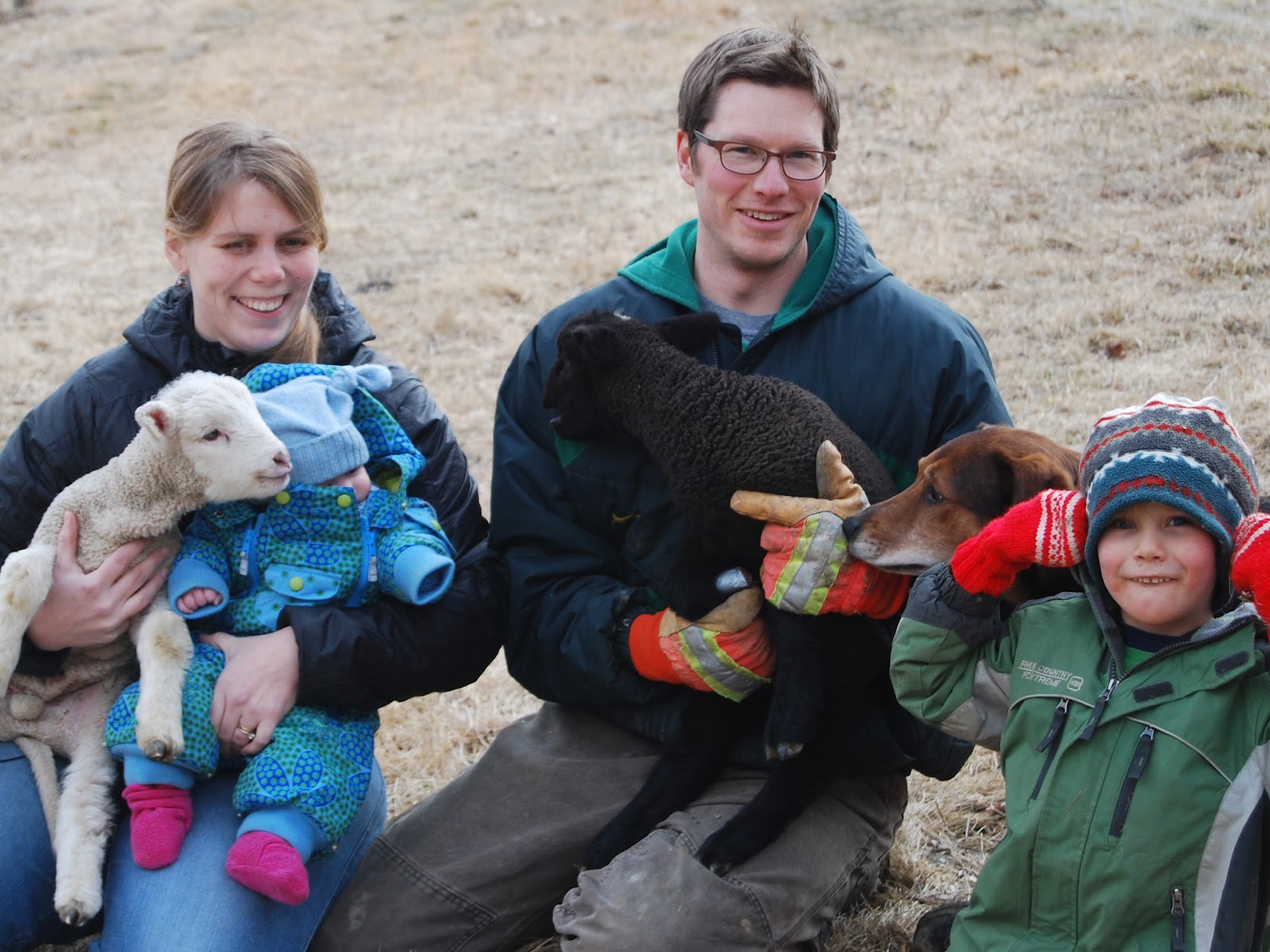
Schulyer and Colby Gail with their two children.
This doesn’t mean that the Gails are opposed to progress. Indeed, the success of this endeavor is made possible through technology. Changes in electric fencing equipment make it possible for pigs to live more naturally, roam more. Inexpensive plastic fencing is easy to put down and take up every few days. It’s cheaper and much more efficient to put down than normal pens. Colby and Schuyler don’t need to dig holes to keep the pigs in one pen. They just rotate the pigs around every few days using plastic fencing that retails for about 30 cents a foot.
Schulyer became a vegetarian as a kid because she thought animal cruelty was wrong. Despite the fact that she started eating meat again two years ago, she still believes she’s avoiding being cruel to her animals.
“Our pigs are never nervous,” she says. “Our pigs are never scared.” (A previous version of this article misstated the acreage of Climbing Tree Farm. It is 390 acres. We also also misstated the length of time the pigs are kept fenced in one area. It depends on the amount of food available. We also misstated the gallons of whey and milk the Gails receive. They get 300 gallons of whey every ten days and 100 to 200 gallons of milk each week. We also misstated the foraging crops the Gails plan to plant. They will not plant soybeans. We also misstated the diet of the pigs. They do not eat hops, but local barley. We also misstated the type of meat the Gails raised when starting out. They raised sheep. Finally, we also misstated the price of the Gails’ pork. It is around $4.25. We regret the errors.)
As a teenager I used to read Countryside Magazine and wish I was a farmer....sometimes wishes come true.
Thank you Heather Smith Thomas and Countryside!
Schuyler Gail
Making a Small Farm Work
Heather Smith Thomas
Schuyler and Colby Gail with their son Huck (now 6), daughter Tillie (2), and pooch Heidi, on their Lebanon, New York homestead.
Schuyler Gail and her husband Colby started farming several years ago, and she has been going through a Holistic Management Beginning Women Farmer Training Program. “We got our first sheep eight years ago when we were caretakers for the farm where my grandmother grew up. We needed to find a way to get rid of the tall grass around the barns, and someone gave us eight sheep. We fenced off the barnyard and let the sheep have that part of the farm. They hadn’t been sheared for three years and they were so shaggy we couldn’t even tell which ones were male or female. We’d never had sheep before,” says Schuyler.
“We had them sheared soon after they arrived and discovered we had three rams. We kept one ram and processed the other two,” she says. The sheep started having lambs, and Schuyler and her husband started selling the meat to friends and acquaintances.
“After we had sheep and had to take care of them—and couldn’t leave home as easily—we got chickens. The first year we had 25 chickens, the next year we had 100, and the year after that we had 1,300. Until I took the beginning farmer class, we did everything by trial and error,” she says.
“That’s how we started farming. We realized very quickly that parking sheep in a barnyard is not a good long-term plan. We branched out to pasturing other parts of my grandmother’s farm, and the sheep kept having more lambs. We learned about moving them to different pastures to make this more sustainable, and then we learned to divide the pastures with electric net fencing,” she explains.
Their friend Morgan Hartman (of Black Queen Angus) is a grass farmer, and he helped them learn more about creating a grazing program. “We started going to conferences and discovered HMI (Holistic Management International),” says Schuyler.
“Our animals were turning the pastures into a golf course and we realized they soon would not have enough food. They accomplished the goal of mowing, but we wanted to be able to feed them year-round. At that time our goal was just mowing, and now it’s managing for meat,” she says.
The majority of their farm livestock now is pigs, several different heritage breeds including Mulefoot, Red Wattle, Large Black and Old Spot. “We are starting to farrow our own pigs. We feed them dairy, gleaned fruits and vegetables from produce farms, and whey from local cheesemakers. We are experimenting with planting forage like mangles for winter feed. The pigs probably get 10% of their food from purchased local grain, so we are trying to eliminate purchased grain.”
Most of the pigs range in the woods. “We had them on pasture last year but they didn’t seem as happy as they do in the woods—where they are harvesting more of their own food and have more room to explore,” she says.
“We just started a CSA and are in a cooperative venture with our neighbors and a friend, Cynthia Creech, who has been raising grass-fed beef for 30-some years, and with the Abode Farm—a horse-powered vegetable farm. Cynthia raises Randall cattle (a rare breed that originated in New England). When she started there with her cattle, there were only nine of these cows left. She has a genetic program that helped build several herds,” says Schuyler.
“Through the CSA we sell chickens, turkeys, eggs and pork. We also raise grass-fed lambs. Most of our business is done through restaurants and stores,” she explains.
“When we moved to our new farm two years ago, we had our laying hens fertilize the area where we wanted to put a garden. Then we put pigs there, then a cover crop, and then had our neighbor till it last spring. Now we are starting to grow forage there—mostly mangles and turnip—for the pigs and sheep.”
The Land
Two years ago she and her husband were able to purchase 20 acres through the Land Conservancy—a piece of land that had not been farmed for more than 50 years. “We bought it from a family who had owned it as a second home. They had waited 12 years on a land match program for a farmer who would want to lease it. Once they found us they were so excited about it that they sold it to us,” she says.
“When we moved here it had been brush-hogged a few times over the past 50 years or so but was mostly goldenrod (taller than me!) and brambles. Everyone who came to visit asked if we were going to have it mowed, but we didn’t. We rotationally grazed the pigs, sheep and poultry for a year, and now the fields look like fairly decent pasture again. There is some bramble and goldenrod left, but there is also a lot of clover and other desirable plants returning—without having to seed them. In the woods our pigs are clearing out the underbrush and brambles, and we have pasture grasses and clover moving in where the pigs have been,” says Schuyler.
Colby moves the free range shelters to fresh pasture.
“So now we own 20 acres and are also leasing from a neighbor who asked us to farm her land in hopes of getting an agricultural exemption for tax purposes. We have a one-year trial lease with the neighbor, trying to see how much of her acreage we can get this ag exception on. It’s 370 acres and only half a mile from our house, so this was wonderful luck,” she says.
“In our area, leasing is very helpful for farmers and land owners both. The land that we are leasing was seized by the state in the 1990s. It was going to be put up for auction and developed, and the current owner bought it so that it would not be developed, to keep it in agriculture. Property taxes are very high in New York State. It’s nice that the land owner can get a break on taxes because it is once again being used for farming.”
Before the Gails moved here, the land they are leasing had an unfinished foundation for a giant house with a helicopter pad—a flat area created by blowing the top off a mountain. That area is just shale, with no topsoil. “One of the reasons the current landowner is leasing to us is that she wants us to rehabilitate that land, and get some soil and plants growing again. We will put animals there in the winter. It will have a lot of manure to start building some soil. This is a huge long-term project,” she explains.
Lessons Learned and Class Benefits
There are several beneficial lessons from the class she’s been taking. “We didn’t consider ourselves in our planning, before. Now, as things progress, we realize we need to plan for ourselves and our family as well as our animals and our land. We want to be able to have more time to play with our kids,” she says. It’s hard to juggle everything.
“In the beginning we didn’t have a financial plan, and we are still working on that. We had never examined our various enterprises to see what was making money and what wasn’t. Now, based on our plan, we raised the prices on our eggs and chicken, and I explained to our customers the reason for this. I don’t think any of them would like the fact that we were losing money to produce food for them. People who are buying the kind of food we produce are doing it at least partly for a social reason and if we are not making any money doing this then they won’t want it,” she says. Farmers have to be able to make a living producing food.
Schuyler enjoys the people in her class. “We have continued to use one another for second opinions on various things. This has been helpful. When you have friends that aren’t farming, your life is so different from theirs that they just don’t understand.” The group of women farmers in her class has been friends, mentors and support group when needed. This is a rewarding experience for all of them.
Challenges of Small-Farming
“A lot of people think our life is very quaint and simple. Some of the people I know from high school tell me that I’m living their dream—having kids and farming. The dream and the reality are probably very different,” she says.
“In this part of the country there is an unrealistic image of farming. I saw an article stating that the popular thing to do when you get out of college is to spend time on an organic farm for a couple of years. But how can farming be sustainable if we are expecting new people to do it, and only briefly, and we’re not taking care of the people who hold the knowledge, who are in it for the long term,” she says.
Children who grow up on a farm have advantages over city kids. They are more grounded in the realities of life and where their food comes from. “A while back, a chef made us head cheese, and offered some to our six-year-old son. Our son asked what it was and the chef told him it was pig head. Our son said it was really good. Most kids would not have even tried it,” says Schulyer.
“One of the sweetest things our kids said was just after we had a runty pig that was here longer than her littermates. We don’t usually name the animals, but our son called her Funny Eyes because she had blue eyes. When it was time for her to go he was so upset that he wouldn’t even say good-bye to her. When we got home from the slaughter-house he asked if we saved her heart and we told him we did, and asked him why. He said, ‘Now we can eat it and save all of her love.’ I thought that was a very meaningful thing for a little boy to say.”
“Farming is a really great thing for young college graduates who want to try it, but I wonder how farming can continue to exist for families with young children. We need to be able to provide for our kids, and this system makes it hard to do that,” she says. Most people in agriculture are underpaid because Americans spend less than any other nation for their food—and tend to take their food for granted.
“The fact that organic farming is touted as the new, cool thing for young people is also hurting it, and it is using these young people as free or cheap temporary labor,” says Schulyer. Some people stick with it and do it because they love this way of life, but it can be very difficult to make a living at it.
Another problem with today’s small farms is that most people who try this are new at it. In earlier times almost everyone had ties with the land. Then there was an exodus to the cities and fewer farmers had to raise more and more food. The farms got bigger and more mechanized. Now there is a move back to the land, but the people coming back grew up in cities and don’t know about farming, and it’s like starting all over. We’ve lost a lot of people who know how to farm.
“Most of the things we are learning today was known for centuries, and then got lost. One thing we’ve tried to do is become friends with older farmers who are the age of our parents and grandparents. If we work together with them, we can learn from each other. For instance there is a dairy farmer here that we know and love, whose family has been farming the same land for many generations. He is doing it largely the way his ancestors did it, but is selling all his milk to the dairy co-op. If he were to milk his 80 cows differently and market the milk a different way, he could be making money instead of losing money every year. Old farmers and new farmers could share knowledge and improve their farms and businesses together.”
We often say that what we like best about farming is that almost every day there is a puzzle to solve.
This week the transmission on our farm truck broke, and we stopped being able to drive in reverse in our truck. We try really, really hard not to put ourselves in debt. Since winter is usually our slowest time of the year financially, Colby has decided that his new challenge is to do all of his farm work without ever having to back-up...which makes tasks like hooking up a trailer pretty tricky, but he's got a plan! He will always park the trailer at the bottom of a hill and roll into place. What seemed like a huge bummer, and an expense we didn't budget for, has now become a fun new game!
Here's an example of another recent "truck puzzle:"
Young Mulefoot (about 60 lbs.) finding acorns that other pigs overlooked.
Colby recently combined three groups of pigs into a single group in a large wooded section. A mother sow (350-400 lbs), twenty piglets (around 75 lbs. each), four Mulefoot piglets (around 60 lbs each), and seventeen (150-200 lbs. pigs) are now living in this section. Colby did this to cut down on his daily chores...the fewer locations he has to feed in, the less time he spends driving around the farm with a truck full of milk, and the more time he has for making new fences to move the pigs into new areas. But, we're hoping for another benefit too.
A mother pig and twenty piglets weighing around 75 lbs. each were in this fence for a couple of weeks before the other two group of pigs arrived (its about 35 acres in size- so there is plenty of room for this many pigs!). The original group had been foraging fairly well. Despite the fact that we gave them their own special pan of grain and milk, the Mulefoot youngsters immediately began digging, and finding acorns right outside of the Pig Palace, which should be the most thoroughly searched for nuts. These little guys sure do now how to forage!
The other group of pigs that we moved into this section is a group that was born on our farm to sows we raised from piglets. We have watched mother pigs teach their piglets to forage. The sows root with their noses, and push the tiny piglets into the ground they have just opened to let the piglets discover what they have uncovered. This is a group of very skilled foragers. Their foraging ability seems to grow with each generation, as mothers pass on their knowledge to their offspring. Our goal is to breed a line of pigs that are exceptional foragers, who will eschew grain for what they find in the forest.
We are hoping that in addition to sows teaching babies to forage, these three groups will share knowledge and become exceptional foragers.
Stephen (our logger/friend) and Colby putting rafters on the pig palace
The palace measures about 25x20 and is about 4-6 feet tall.
We are working in conjunction with Stephen, who is selective cut logging our leased land. When he came out of this section of the forest we put the pigs into it. Stephen used his skidder to create a low wall made from big stumps set opposite from an old stone foundation. The pig palace is tucked in from the wind, its sturdy, and when filled with hay and warm pigs it is quite cozy.
Butter (the mother pig) and the Butter-pats (piglets).
Often, when people hear we are farmers they say something like "oh, how nice, so you have the winters off?" I am here to say this is not so... I can't speak for vegetable farmers, because I am not one, but work does not cease on a livestock farm during the winter or otherwise; not in the winter, nor on our Birthdays, nor on Christmas. Animals eat, and have needs every day, year round. What does change is the kinds of work we do, the population on the farm, and the weather.
We do not keep poultry over the winter (in the past we kept laying hens, but found that they did not thrive in the housing we could provide them with during the coldest months at our new farm). We do keep sheep and pigs over the winter. January through March is lambing time at our farm, which brings its own special set of chores. We will begin farrowing (having piglets) in the winter later this season. Housing requirements are greater in the winter- which means Fall and Winter are times for harried construction projects, and winter is a time of lugging bedding. Water is a big issue in the winter, because automatic waterers freeze, water must be carried to the animals daily (or often a few times during the day), and ice must be chipped. Our pigs drink a LOT of dairy, which must either be transferred to a heated tank or by the crate into our basement so that it doesn't freeze, and then distributed daily to the pigs. Swift shifts in the weather, and prolonged extreme cold can be hard on the animals, with pneumonia being a particular threat to smaller piglets (though thankfully we have avoided this completely so far this year!). Changing weather conditions make it hard to tell what to expect each day during our chores, and difficult to plan transportation to slaughter or to new forage- we've been alternating deep snow, and deep mud this year! We gain two (nearly full) days each week after holiday farmer's markets dwindle in Mid-late December...which is bitter sweet. We love seeing our customers each week and depend on the income we make there, but it feels fabulous to eat pancakes and play with play dough on a Sunday morning with our kids. (I counted and think we went to 48 farmer's markets this year!- We will have to eat a lot of pancakes this winter to make up for those lost weekend mornings with our kids!).
While we don't have the winters off, our life is good (and busy) year round.
Transferring milk to heated tanks.
This has GOT to be one of the coldest jobs ever done by the human hand.
A common winter scene indoors at our house...one kid making pancetta, the other making bacon.
Butter-pats roughly one month later- growing well in the winter woods




 “Our animals were turning the pastures into a golf course and we realized they soon would not have enough food. They accomplished the goal of mowing, but we wanted to be able to feed them year-round. At that time our goal was just mowing, and now it’s managing for meat,” she says.
 “We just started a CSA and are in a cooperative venture with our neighbors and a friend, Cynthia Creech, who has been raising grass-fed beef for 30-some years, and with the Abode Farm—a horse-powered vegetable farm. Cynthia raises Randall cattle (a rare breed that originated in New England). When she started there with her cattle, there were only nine of these cows left. She has a genetic program that helped build several herds,” says Schuyler.

 “In our area, leasing is very helpful for farmers and land owners both. The land that we are leasing was seized by the state in the 1990s. It was going to be put up for auction and developed, and the current owner bought it so that it would not be developed, to keep it in agriculture. Property taxes are very high in New York State. It’s nice that the land owner can get a break on taxes because it is once again being used for farming.”


 “In our area, leasing is very helpful for farmers and land owners both. The land that we are leasing was seized by the state in the 1990s. It was going to be put up for auction and developed, and the current owner bought it so that it would not be developed, to keep it in agriculture. Property taxes are very high in New York State. It’s nice that the land owner can get a break on taxes because it is once again being used for farming.”


