Formerly,Bar None Ranch, of Berlin, NY, we are now Climbing Tree Farm, of New Lebanon. We raise PASTURED POULTRY, LAMB, GRASS-FED BEEF, and WOODLAND/PASTURE-RAISED, MILK-FED PORK. We keep our animals true to their instincts- letting our pigs dig, our chickens range, our sheep graze. We feed rotationally graze on pasture and silvo-pasture (in the woods). We work with a local dairy to feed our pigs Jersey milk. We are conscientious stewards of the land, and our animals.


Please visit our website climbingtreefarm.com
or contact us with questions or to place orders.


Showing posts with label Articles by Others. Show all posts

Sunday, February 22, 2015

Darrow School Comes to Climbing Tree

Students helping Colby move a round bale.
 
We're working with Darrow school, a private high school in New Lebanon. The students have been challenged to recreate one of the most ubiquitous products in America - the McDonald's Happy Meal - from scratch, using only what we can find around us. They have been working with local farmers to help them learn some basic skills like cheese-making or bread-making, and they are trying to grow small pots of produce in various locations on campus.  They are also raising chickens right now in the biology classroom - for meat, not eggs - and another farmer is going to help them slaughter and render them for cooking.  Another team is working on the packaging - both paper and ink.

Ultimately, the goal of the project is to learn something about how we sustain ourselves - locally, nationally and globally - and to begin to think about whether what we are doing is in fact sustainable.  This challenge is the core project in 9th grade history - it was meant to lure the kids into examining essential questions about human geography.

The students are learning project management, how to use social media to advocate for change, research and writing, and self-reflection and evaluation, in addition to content.

For a longer description, you can read this:

Here are some examples of student research:


We've been surprised and excited by how insightful, curious, and thoughtful these students are. We look forward to watching their mistakes and successes (both important!) throughout this project, and can't wait to see what they come up with for a finished project.


Sunday, February 2, 2014

Modern Farmer- Hog Wild: Raising Instinctual Pork

Modern Farmer is one of our favorite farmy reads.

It was a real thrill to be featured in Modern Farmer Online!

Thank you Daniel Luzer, Morgan Ione Yeager, and Modern Farmer!

Modern Farmer

Hog Wild: Raising Instinctual Pork

Photography by Morgan Ione Yeager
These aren't your average pigs.
Schuyler Gail may have been a vegetarian until two years ago, but today she’s known for her pork. Along with her husband, Colby, Schulyer raises pigs – as well as chickens and sheep — at Climbing Tree Farm, a 390-acre farm in New Lebanon, New York.
And it’s not just any pork. While much of the appeal of “natural” meat, at least as far as advertising goes, is to return to the way Americans raised animals 60 years ago, on small farms with rusty tractors and pig pens, the Gails are attempting something more revolutionary: To raise pigs the way our peasant ancestors did — freely, and in the woods.
This means that the Gails’ pigs have an uncommon diet. Most of their food is foraged from the land around them. The pigs are kept in small groups in pens between a quarter of an acre and 2 acres in size, rotating from pen to pen depending on the amount of food available.
“Pigs are meant to forage. That’s how wild pigs survive,” says Jazu Stine, a butcher in Pittsfield, MA. “The notion of a pig pen has to do with our needs as pork consumers, not their needs as animals. They’re naturally prone to dig and root.”
Instinctual pork is a relatively new trend. Farmer Joel Salatin, profiled in Michael Pollan in The Omnivores Dilemma, raises pigs on his Shenandoah Valley farm this way. Animal scientist Temple Grandin has also done work in this area. But trying to go out and buy pork for dinner and know it’s been raised like this is impossible for the average consumer. But now, thanks to farmers like the Gails, this is changing.
About half of the Gails’ pigs’ diet consists of plants growing around them. Another quarter comes from supplemental crates of expired milk, buttermilk, and whey given to the farmers from local dairies — giving the goods away is cheaper than throwing them out. This means that the Gails get 300 gallons of whey every ten days and 100 to 200 gallons of out-of-date milk a week to feed the 50 to 75 pigs they keep at a time. (They slaughter 1 to 3 a week.) The final quarter of the pigs’ diet comes grain. The Gails are using some commercial grain now, but plan to plant more foraging crops in future years — turnips, pumpkins and rye — and wean the pigs from feed altogether.
“Pigs are meant to forage. That’s how wild pigs survive”
Humans started to put pigs in pens for a very understandable economic reason. Historically pigs were hard to contain and farmers built fences to keep them together. “Keep them in a small pen in dirt, they’ll still grow fat and be okay to eat,” says Stine. “That’s true, but it doesn’t mean that that’s the way pigs exist naturally, and it doesn’t mean the meat is awesome.”
And this sort of diet does change the taste of the pork. “What you get is a different quality of fat,” Stine says. Pigs raised instinctually have access to antioxidants and omega-3 fatty acids, which are good for fighting disease and maintaining healthy metabolism. This is rare in commercially-raised pork.
Because the Climbing Tree Farm pigs eat local barley, old pumpkins at Halloween, fallen apples from local orchards, the flavor of the pork changes, too – seasonally. “The meat tastes different depending on what the pigs ate,” says Schuyler.
Colby, 33, and Schuyler, 31, met while teenagers at summer camp in the Pacific Northwest. Longtime gardeners, they first began farming with a few sheep part-time on Schuyler’s grandmother’s farm in Berlin, New York in 2005. But once the animals started to breed and Colby and Schuyler were producing more lamb than they needed, they branched out into full time farming.
While the flavor of this kind of pork is unrivaled, how affordable is it for the farmers? The upfront costs are high, particularly because the farmer needs to have a lot of land in order to move the animals every few days so the pigs can forage food. As Colby explains, however, the quality of the land doesn’t matter much. Any property will do. Farmers also don’t need much infrastructure. “We think that this is a better way to go about it than, you know, taking out a mortgage to build big barns like others do it,” Schuyler says.
Commercial farmers can produce thousands of pounds of meat a day. “For large farms the day-to-day costs go way down,” Stine says.  Instinctual pork farmers need larger plots of land and fancier food options. But once they have it, Stine explains, the price of running such a thing also goes way down. “It comes down to numbers and getting the right ratio.” Colby and Schuyler can get about $4.25 a pound for many breeds of their instinctually raised pork. “Commercially raised pork is more like pennies on the pound, but they make up for that in volume. It’s a classic case of a quality over quantity.”
The Gails also raise sheep and chickens at Climbing Tree
The Gails have worked hard to cut costs. They have no barn and no tractor. In the winter they often carry food and water to the animals in an old canoe they attach to a 4-wheeler, “like an old fashioned bob sled,” Schuyler says. They have made movable shelters for their animals out of pallets and old above-ground pool siding. They use a teepee, which they bought off of Craigslist, to store feed. The pigs eat from feed troughs made from PVC piping that Colby found discarded on a construction site.
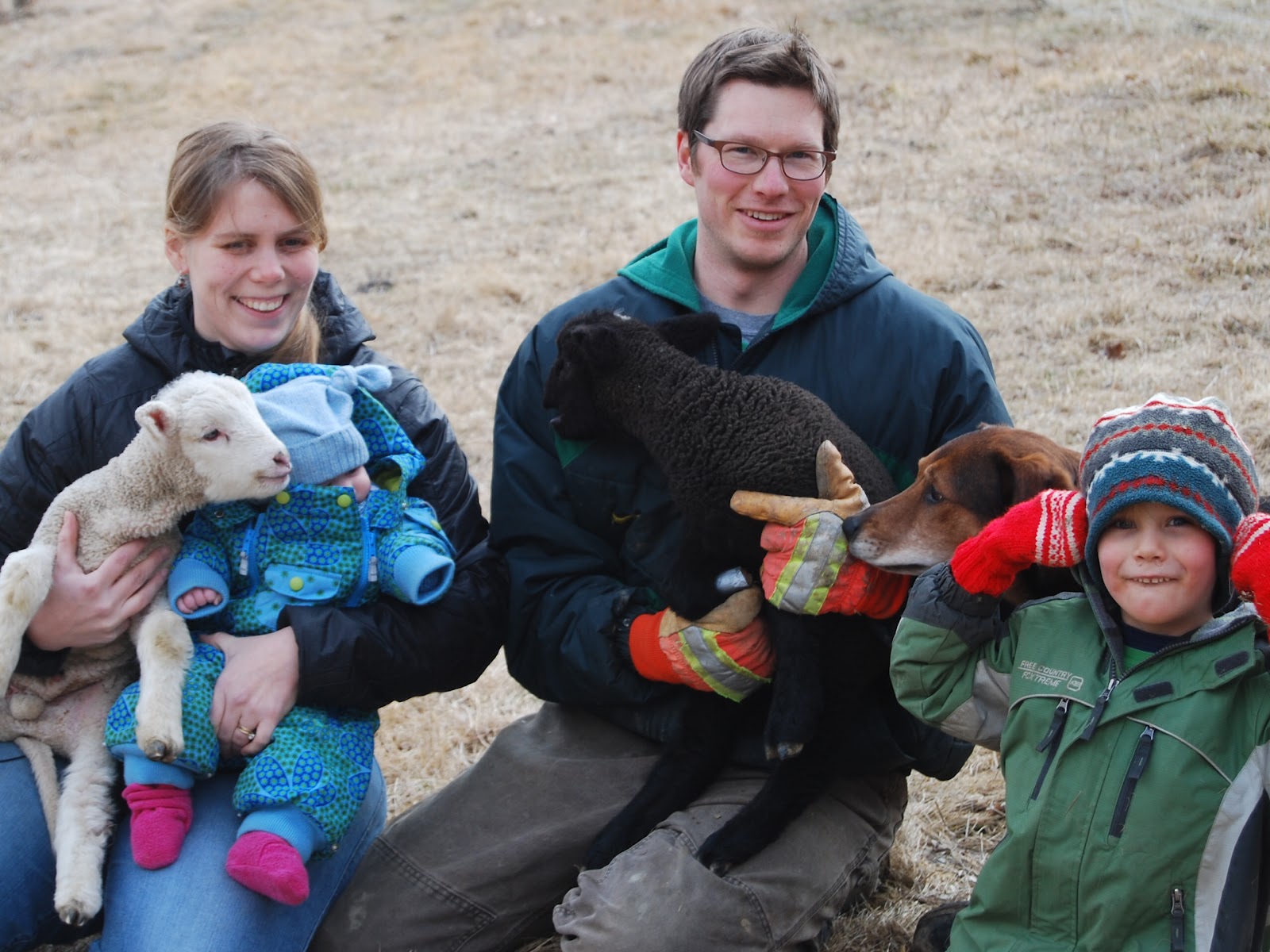
Schulyer and Colby Gail with their two children.
This doesn’t mean that the Gails are opposed to progress. Indeed, the success of this endeavor is made possible through technology. Changes in electric fencing equipment make it possible for pigs to live more naturally, roam more. Inexpensive plastic fencing is easy to put down and take up every few days. It’s cheaper and much more efficient to put down than normal pens. Colby and Schuyler don’t need to dig holes to keep the pigs in one pen. They just rotate the pigs around every few days using plastic fencing that retails for about 30 cents a foot.
Schulyer became a vegetarian as a kid because she thought animal cruelty was wrong. Despite the fact that she started eating meat again two years ago, she still believes she’s avoiding being cruel to her animals.
“Our pigs are never nervous,” she says. “Our pigs are never scared.”
(A previous version of this article misstated the acreage of Climbing Tree Farm. It is 390 acres. We also also misstated the length of time the pigs are kept fenced in one area. It depends on the amount of food available. We also misstated the gallons of whey and milk the Gails receive. They get 300 gallons of whey every ten days and 100 to 200 gallons of milk each week. We also misstated the foraging crops the Gails plan to plant. They will not plant soybeans. We also misstated the diet of the pigs. They do not eat hops, but local barley. We also misstated the type of meat the Gails raised when starting out. They raised sheep. Finally, we also misstated the price of the Gails’ pork. It is around $4.25. We regret the errors.)

See the article in its original location here:
http://modernfarmer.com/2013/11/hogs-untied-raising-instinctual-pork/

A Teenaged Dream Come True

As a teenager I used to read Countryside Magazine and wish I was a farmer....sometimes wishes come true.

Thank you Heather Smith Thomas and Countryside!


Dairy Goat Journal. Presenting information, ideas, and insights for everyone who raises, manages, or just loves dairy goats.

Schuyler Gail

Making a Small Farm Work

Heather Smith Thomas

Schuyler-Colby&kids
Schuyler and Colby Gail with their son Huck (now 6), daughter Tillie (2), and pooch Heidi, on their Lebanon, New York homestead.
Schuyler Gail and her husband Colby started farming several years ago, and she has been going through a Holistic Management Beginning Women Farmer Training Program. “We got our first sheep eight years ago when we were caretakers for the farm where my grandmother grew up. We needed to find a way to get rid of the tall grass around the barns, and someone gave us eight sheep. We fenced off the barnyard and let the sheep have that part of the farm. They hadn’t been sheared for three years and they were so shaggy we couldn’t even tell which ones were male or female. We’d never had sheep before,” says Schuyler.
“We had them sheared soon after they arrived and discovered we had three rams. We kept one ram and processed the other two,” she says. The sheep started having lambs, and Schuyler and her husband started selling the meat to friends and acquaintances.
“After we had sheep and had to take care of them—and couldn’t leave home as easily—we got chickens. The first year we had 25 chickens, the next year we had 100, and the year after that we had 1,300. Until I took the beginning farmer class, we did everything by trial and error,” she says.
“That’s how we started farming. We realized very quickly that parking sheep in a barnyard is not a good long-term plan. We branched out to pasturing other parts of my grandmother’s farm, and the sheep kept having more lambs. We learned about moving them to different pastures to make this more sustainable, and then we learned to divide the pastures with electric net fencing,” she explains.
Their friend Morgan Hartman (of Black Queen Angus) is a grass farmer, and he helped them learn more about creating a grazing program. “We started going to conferences and discovered HMI (Holistic Management International),” says Schuyler.
Schuyler- march2013“Our animals were turning the pastures into a golf course and we realized they soon would not have enough food. They accomplished the goal of mowing, but we wanted to be able to feed them year-round. At that time our goal was just mowing, and now it’s managing for meat,” she says.
The majority of their farm livestock now is pigs, several different heritage breeds including Mulefoot, Red Wattle, Large Black and Old Spot. “We are starting to farrow our own pigs. We feed them dairy, gleaned fruits and vegetables from produce farms, and whey from local cheesemakers. We are experimenting with planting forage like mangles for winter feed. The pigs probably get 10% of their food from purchased local grain, so we are trying to eliminate purchased grain.”
Most of the pigs range in the woods. “We had them on pasture last year but they didn’t seem as happy as they do in the woods—where they are harvesting more of their own food and have more room to explore,” she says.
Schuyler, Colby & children“We just started a CSA and are in a cooperative venture with our neighbors and a friend, Cynthia Creech, who has been raising grass-fed beef for 30-some years, and with the Abode Farm—a horse-powered vegetable farm. Cynthia raises Randall cattle (a rare breed that originated in New England). When she started there with her cattle, there were only nine of these cows left. She has a genetic program that helped build several herds,” says Schuyler.
“Through the CSA we sell chickens, turkeys, eggs and pork. We also raise grass-fed lambs. Most of our business is done through restaurants and stores,” she explains.
“When we moved to our new farm two years ago, we had our laying hens fertilize the area where we wanted to put a garden. Then we put pigs there, then a cover crop, and then had our neighbor till it last spring. Now we are starting to grow forage there—mostly mangles and turnip—for the pigs and sheep.”

The Land

Two years ago she and her husband were able to purchase 20 acres through the Land Conservancy—a piece of land that had not been farmed for more than 50 years. “We bought it from a family who had owned it as a second home. They had waited 12 years on a land match program for a farmer who would want to lease it. Once they found us they were so excited about it that they sold it to us,” she says.
“When we moved here it had been brush-hogged a few times over the past 50 years or so but was mostly goldenrod (taller than me!) and brambles. Everyone who came to visit asked if we were going to have it mowed, but we didn’t. We rotationally grazed the pigs, sheep and poultry for a year, and now the fields look like fairly decent pasture again. There is some bramble and goldenrod left, but there is also a lot of clover and other desirable plants returning—without having to seed them. In the woods our pigs are clearing out the underbrush and brambles, and we have pasture grasses and clover moving in where the pigs have been,” says Schuyler.
Colby moves the free range shelters to fresh pasture.
“So now we own 20 acres and are also leasing from a neighbor who asked us to farm her land in hopes of getting an agricultural exemption for tax purposes. We have a one-year trial lease with the neighbor, trying to see how much of her acreage we can get this ag exception on. It’s 370 acres and only half a mile from our house, so this was wonderful luck,” she says.
Schuyler“In our area, leasing is very helpful for farmers and land owners both. The land that we are leasing was seized by the state in the 1990s. It was going to be put up for auction and developed, and the current owner bought it so that it would not be developed, to keep it in agriculture. Property taxes are very high in New York State. It’s nice that the land owner can get a break on taxes because it is once again being used for farming.”
Before the Gails moved here, the land they are leasing had an unfinished foundation for a giant house with a helicopter pad—a flat area created by blowing the top off a mountain. That area is just shale, with no topsoil. “One of the reasons the current landowner is leasing to us is that she wants us to rehabilitate that land, and get some soil and plants growing again. We will put animals there in the winter. It will have a lot of manure to start building some soil. This is a huge long-term project,” she explains.

Lessons Learned and Class Benefits

There are several beneficial lessons from the class she’s been taking. “We didn’t consider ourselves in our planning, before. Now, as things progress, we realize we need to plan for ourselves and our family as well as our animals and our land. We want to be able to have more time to play with our kids,” she says. It’s hard to juggle everything.
“In the beginning we didn’t have a financial plan, and we are still working on that. We had never examined our various enterprises to see what was making money and what wasn’t. Now, based on our plan, we raised the prices on our eggs and chicken, and I explained to our customers the reason for this. I don’t think any of them would like the fact that we were losing money to produce food for them. People who are buying the kind of food we produce are doing it at least partly for a social reason and if we are not making any money doing this then they won’t want it,” she says. Farmers have to be able to make a living producing food.
Schuyler enjoys the people in her class. “We have continued to use one another for second opinions on various things. This has been helpful. When you have friends that aren’t farming, your life is so different from theirs that they just don’t understand.” The group of women farmers in her class has been friends, mentors and support group when needed. This is a rewarding experience for all of them.

Challenges of Small-Farming

Schuyler -april_018
“A lot of people think our life is very quaint and simple. Some of the people I know from high school tell me that I’m living their dream—having kids and farming. The dream and the reality are probably very different,” she says.
“In this part of the country there is an unrealistic image of farming. I saw an article stating that the popular thing to do when you get out of college is to spend time on an organic farm for a couple of years. But how can farming be sustainable if we are expecting new people to do it, and only briefly, and we’re not taking care of the people who hold the knowledge, who are in it for the long term,” she says.
Schuyler-april2013
Children who grow up on a farm have advantages over city kids. They are more grounded in the realities of life and where their food comes from. “A while back, a chef made us head cheese, and offered some to our six-year-old son. Our son asked what it was and the chef told him it was pig head. Our son said it was really good. Most kids would not have even tried it,” says Schulyer.
“One of the sweetest things our kids said was just after we had a runty pig that was here longer than her littermates. We don’t usually name the animals, but our son called her Funny Eyes because she had blue eyes. When it was time for her to go he was so upset that he wouldn’t even say good-bye to her. When we got home from the slaughter-house he asked if we saved her heart and we told him we did, and asked him why. He said, ‘Now we can eat it and save all of her love.’ I thought that was a very meaningful thing for a little boy to say.”
“Farming is a really great thing for young college graduates who want to try it, but I wonder how farming can continue to exist for families with young children. We need to be able to provide for our kids, and this system makes it hard to do that,” she says. Most people in agriculture are underpaid because Americans spend less than any other nation for their food—and tend to take their food for granted.
“The fact that organic farming is touted as the new, cool thing for young people is also hurting it, and it is using these young people as free or cheap temporary labor,” says Schulyer. Some people stick with it and do it because they love this way of life, but it can be very difficult to make a living at it.
Another problem with today’s small farms is that most people who try this are new at it. In earlier times almost everyone had ties with the land. Then there was an exodus to the cities and fewer farmers had to raise more and more food. The farms got bigger and more mechanized. Now there is a move back to the land, but the people coming back grew up in cities and don’t know about farming, and it’s like starting all over. We’ve lost a lot of people who know how to farm.
“Most of the things we are learning today was known for centuries, and then got lost. One thing we’ve tried to do is become friends with older farmers who are the age of our parents and grandparents. If we work together with them, we can learn from each other. For instance there is a dairy farmer here that we know and love, whose family has been farming the same land for many generations. He is doing it largely the way his ancestors did it, but is selling all his milk to the dairy co-op. If he were to milk his 80 cows differently and market the milk a different way, he could be making money instead of losing money every year. Old farmers and new farmers could share knowledge and improve their farms and businesses together.”
 
Visit the Gails at http://climbingtreefarm.blogspot.com.

See this article in Countryside Magazine or online here:
http://www.countrysidemag.com/articles/schuyler-gail-making-a-small-farm-work/

Sunday, August 4, 2013

Berkshire Eagle Article About Climbing Tree Farm!

In their field: Climbing Tree Farm lets animals roam


By Francesca Shanks, Berkshire Eagle Staff


NEW LEBANON, N.Y. -- You can tell the pigs are happy at Climbing Tree Farm, because they play. They have lots of room to roam, lots of good things to eat and two children who love them as animals, then love them as food. The Gail family has been at their home, on 20 acres in New Lebanon, for a year and a half now. Husband and wife Colby and Schuyler, 33 and 31, and their children, Huck, 6, and Tillie, 1, have tried to keep their sheep, chicken and pigs raised as naturally as possible. "We feed really differently than most farms," Schuyler said. "I think there's a trend for pork producers to sort of feed whatever they can find -- every decision we make on our farm is calculated. We're focused on making the very best product we can possibly make." These animals are pasture-raised -- there's no barn at Climbing Tree. No permanent fencing, no silo. "Everybody is on grass, outside, year-round, and continually moving," Colby said. There's just one exception -- baby chicks stay in for two weeks or so, and the chickens do have housing to keep them safe from predators. There's no tractor -- when they got to the property the grass and weeds grew tall, but the animals, as they are moved around, have largely taken care of that. There are about 50 pigs (a sow who was pregnant when I visited has certainly had her babies by now), 45 to 50 sheep, and many, many chickens and turkeys. Colby said the Gails have never lost a sheep or a pig to a predator. Since they got a flock of African and Embden geese to use as guardians, they haven't lost a chicken, either. Schuyler is from William stown, and she and Colby, who is from Utah, started farming when they lived next door to her grandmother as caretakers. "We always wanted to grow food for our eventual family," she said. "Someone gave us some sheep to keep the grass around the barns down. We realized we really liked growing food for other people." Their land borders hundreds of acres they lease through the Columbia Land Conservancy's Farmer Landowner Match program, which helps those with acreage find those seeking to farm it. A lot of it is a shale field, and the family farm philosophy is to be gentle, to help rehabilitate what secures their livelihood. "We're not just doing this to have a product to sell," Schuyler said. "We want to heal this land." Schuyler and Colby said they love working with the animals, and no two days are ever the same -- "every day there's a puzzle to be solved. There's a creative aspect to it," Schuyler said. "There's a lot of drudgery also. In a way, having no infrastructure to speak of is actually a blessing. It makes us come up with ways of doing things that are more sustainable." When I asked about the worst part, it didn't take long for Schuyler to answer, "I really don't like castrating pigs." But also, "it's hard for us to sort of distinguish ourselves." "I think there are blanket statements flying around -- pasture-raised, pasture-fed, that can mean a lot of different things," Colby said. "We feel like we're grouped into one sort of ball, and it doesn't necessarily explain what we're doing here and what our goals are." It's also hard to do farm work and take care of two young children simultaneously, Schuyler said. The kids love the animals -- Huck, upon finding out turkeys were coming, said, "I didn't know that -- can I hold one immediately?" -- and Schuyler chronicles farm life at climbingtreefarm.blogspot.com, which has plenty of pictures of happy kids holding goslings, piglets and so on. The kids are also completely casual about the fact these creatures are food. Schuyler, who was once a vegetarian, said people are often emotional about eating animals they have known and interacted with -- but "I don't know how you can eat an animal that you don't know where it comes from," she said. Though they have been at it for years, and have been educating themselves since they realized farming was what they wanted to do, "we're never fully educated. We never will be," Schuyler said. Huck, playing with a turtle named Ninja as I spoke to the family in their living room, disagreed. "Yes, we will," he said.

Recipe
Climbing Tree Farm grilled pork chops with chive butter
(Serves two)

Chive butter
(Huck gave me some chives):
1 stick butter
A handful of chives, diced
Melt butter; put in small mason jar or other container.
Drop in chives; let rest, stirring when butter begins to separate.
Refrigerate when butter becomes solid.

Chops
Two pork chops
 Chive butter
 Salt, pepper
Rub chops with salt and pepper.
Heat grill to medium-high heat.
Rub chops with chive butter; refrigerate while grill gets hot.
Use hottest part of grill and keep chops there one minute each side to get a nice sear, then move them away from flame, grilling three minutes each side or until juice runs clear.

 Enjoy!
You can also grill some corn, too, and rub the chive butter on it, which I really think you should do.
What: Climbing Tree meat
 Where: New Lebanon Farmers Market
 When: Sundays, 10 a.m. to 2 p.m.
Where: Downtown Pittsfield Farmers Market
 When: Saturdays, 10 a.m. to 2 p.m.
You can also call and pick up meat, including bacon, pork chops, lamb and pork sausage. Where: 436 West Hill Road, New Lebanon, N.Y.
Information: (413), 884-3446, bigbug9@juno.com, or climbingtreefarm.blogspot.com

Originally found here:
http://www.berkshireeagle.com/berkshiresweek/ci_23708400/their-field-climbing-tree-farm-lets-animals-roam

Monday, May 6, 2013

NY Times Article: Report on U.S. Meat Sounds Alarm on Resistant Bacteria

This NY Times article is worth a read:


Report on U.S. Meat Sounds Alarm on Resistant Bacteria


The data, collected in 2011 by the National Antimicrobial Resistance Monitoring System — a joint program of the Food and Drug Administration, the Agriculture Department and the Centers for Disease Control and Prevention — show a sizable increase in the amount of meat contaminated with antibiotic-resistant forms of bacteria, known as superbugs, like salmonella, E. coli and campylobacter.
The government published the findings in February, but they received scant attention until the Environmental Working Group issued its report, “Superbugs Invade American Supermarkets,” which was partly underwritten by Applegate, which sells organic and antibiotic-free “natural” meats.
“The numbers are pretty striking,” said Dawn Undurraga, the nutritionist for the group, a health research and advocacy organization. “It really raises a question about the antibiotics we are using in raising animals for meat.”
Academic veterinarians who work with the International Food Information Council, financed in part by major food companies, and with the U.S. Farmers and Ranchers Alliance, which receives some financing from veterinary pharmaceutical companies, criticized the report as misleading.
“The No. 1 misunderstanding about antibiotics in animal agriculture is that it is not understood well enough that antibiotics are used to keep animals healthy, period,” said Randall Singer, a professor of veterinary science at the University of Minnesota.
Professor Singer noted the limited number of samples in the federal data, 480 samples each of ground turkey, pork chops and ground beef, and chicken breasts, wings and thighs, compared with the huge amount of meat sold in the United States. “We should not assume that when we find resistance to antibiotics in humans, it means it was caused by the use of antibiotics in animals,” he said.
Many animals grown for meat are fed diets containing antibiotics to promote growth and reduce costs, as well as to prevent and control illness. Public health officials in the United States and in Europe, however, are warning that the consumption of meat containing antibiotics contributes to resistance in humans. A growing public awareness of the problem has led to increased sales of antibiotic-free meat.
The Agriculture Department has confirmed that almost 80 percent of all antibiotics sold in the United States are used in animal agriculture, and public health authorities around the world increasingly are warning that antibiotic resistance is reaching alarming levels.
“We don’t have a problem with treating animals with antibiotics when they are sick,” Ms. Undurraga said. “But just feeding them antibiotics to make them get bigger faster at a lower cost poses a real problem for public health.”
The F.D.A. has recommended that the use of antibiotics in farm animals be “limited to those uses that are considered necessary for assuring animal health,” but its guidance is only voluntary.
Supermarkets increasingly are labeling meat that does not contain antibiotics, just one sign of the growing consumer awareness of the issue.
The federal researchers tested for the enterococcus bacteria, which is an indication of fecal contamination. Enterococcus also easily develops resistance to antibiotics, and it easily can pass that resistance on to other bacteria.
Two species of the bacteria, Enterococcus faecalis and Enterococcus faecium, are the third-leading cause of infections in the intensive care units of United States hospitals.
Some 87 percent of the meat the researchers collected contained either normal or antibiotic-resistant enterococcus, suggesting that most of the meat came in contact with fecal material at some point.
“That’s a big percentage they’re throwing around, but that organism itself on food or in an animal has little or no relationship to human health,” Professor Singer said.
Of the chicken breasts, wings and thighs the monitors tested, 9 percent of the samples were contaminated with a variety of salmonella that resists antibiotics, while 26 percent contained antibiotic-resistant campylobacter.
Ten percent of the ground turkey tested contained resistant salmonella.
More stark was the proportion of microbes identified that were resistant. Of all the salmonella found on raw chicken pieces sampled in 2011, 74 percent were antibiotic-resistant, while less than 50 percent of the salmonella found on chicken tested in 2002 was of a superbug variety.
This article has been revised to reflect the following correction:
Correction: April 24, 2013
An article last Wednesday about a report that found a sizable increase in the amount of meat contaminated with antibiotic-resistant forms of bacteria misstated part of the name of the organization that issued it. It is the Environmental Working Group, not the Environmental Work Group.
 
 
Find this article at: http://www.nytimes.com/2013/04/17/business/report-on-us-meat-sounds-alarm-on-superbugs.html?_r=0

Monday, April 22, 2013

Know Your Farmer' Pasture


As farmer's we are curious about how other farmers do their work. When we take a drive we always crane our necks as we pass other farms. Some we want to emulate, the ones that have vibrant, bright green grass and healthy animals. Others make us cringe, those are the ones where the animals are up to their knees in mud and feces, and the pigs are eating doughnuts.


We sell "pasture-raised" meats and eggs. In the past several years, the term "pasture-raised" has become increasingly popular. Unfortunately, both the green-grass-farm and the poo-doughnut-farm described above can be marketed as "pasture-raised." Right now there are no qualifications that must be met in order to call one's product "pasture-raised." We're not huge fans of government regulation, and jargon isn't particularly important to us. However, as a farmer who sells "pasture-raised" meats, I feel I owe it to you (as a consumer) to tell you that not all pastures are created equal. In my opinion, calling an animal raised on baked goods in a sloppy poo mess of a field "pasture-raised" is a stretch (at best). People say "know your farmer," which is great, but I say take it further and know your farmers' pasture. I know it's annoying, and that it would be much easier to pick up any old package of meat labeled "pasture-raised," but next time you're on a drive start craning your neck to check out those pastures on the way by. Buy from the farms whose animals are grazing on grass, not turds, and you'll get a tastier, healthier piece of meat, as well as supporting a farmer who takes the time to care for his/her animals and land.

In case you hadn't guessed...ours is the green grass kind of farm.
 

I could go on and on about this, but fortunately Twilight Greenaway already has in this article, which is worth reading:

‘Pasture-Raised’: Can This Under-the-Radar Food Label Go Legit?

Twilight Greenaway ‘Pasture-Raised’: Can This Under-the-Radar Food Label Go Legit?


As the beyond-organic term becomes more popular,

 concerns arise about maintaining its true meaning.


April 5, 2013


Visitng the pasture-raised tukrey at Joel Salatin's Polyface Farm. (Photo: The Washington Post/Getty Images)


“Pasture-raised.” In recent years these descriptive, evocative words have become synonymous with the real thing: Meat and eggs produced on open fields, generally at a scale that is both humane and ecologically friendly. In other words, it has become the anti-factory-farming label, more likely to show up in places like farmers markets and websites advertising animal shares and meat CSAs.

And when it comes to meat, some producers (and their customers) see “pasture-raised” as a step beyond organic. That designation has some standards in place for the animals’ access to the outdoors, but organically raised livestock still often relies heavily on grain-based feed rather than grass and the other wild foods (and bugs) found on open pasture.


Pasture-raised has gone hand-in-hand with practices that are transparent and integrity-filled since 1996, when Joel Salatin used the term in his book Pastured Poultry Profits. But here’s the catch: it may not always. “Pasture-raised” has no rules, no formal definition, no regulation, and therefore no enforcement behind it. And just like “free range,” a term which likely started out as a legitimate claim and now has come to mean very little, “pasture-raised” may be on the verge of mass appeal—and the eventual dilution that comes with it.

In fact, as “pasture-raised” and its cousin “pastured” begin appearing in big grocery stores, on everything from meat to milk and egg cartons, it’s already beginning to raise a number of complicated questions.

Marilyn Noble at the American Grassfed Association admits that a great deal of the meat she buys directly from the local farmers in her area is labeled “pasture-raised” —especially if it’s chicken or pork, which cannot technically be grassfed (a term that only applies to ruminant animals, such as cows, sheep, and bison). But it’s the relationships she has with farmers—and the transparency that allows—rather than the label that keeps her coming back.

“If you see grassfed on a label,” she adds, “it means that the animals were fed nothing but grass and forage from weaning to harvest. And usually there’s been no confinement at any point during their lives. It’s a very broad definition, but if you see it on a label, you know it’s been approved by The Food Safety and Inspection Service (FSIS) and has meaning behind it. Pasture-raised means whatever the person using it wants it to mean.”

Andrew Gunther, Program Director of the third-party certifier Animal Welfare Approved, agrees.

“The problem with ‘pastured’ and ‘pasture-raised’ is that they’re very bucolic. Someone comes up with a nice phrase to evoke a feeling in their production system, and someone else will come along and steal it.”

Case in point? The NatureRaised line that Tyson Foods plans to release this month. The new antibiotic-free product can be seen as a step in the right direction for the chicken giant, but it’s very likely the birds are raised a very long way from anything Nobel or Gunther would recognize as pasture.

“The [pasture-raised] brand has been below the radar,” says Gunther, “and it’s beginning to be on more people’s radars. But if people want to use it with depth and meaning, they have to protect it.” And that, he adds, can only happen by defining it on a formal level—and enforcing that definition.

Kelley Escobedo, who co-owns South Texas Heritage Pork with her husband, Mark, uses the term to describe her products. “I tell people to look for pasture-raised, but I also tell them to get to know your farmer, because I’ve seen farmers use that term very loosely,” she says.

And although the Escobedos started farming—like many do—so they could do things their way, she also now recognizes the value of formalizing (and regulating) the labels we put on our food.

That said, it would be especially tough to regulate a term like pasture-raised, because, as Escobedo puts it, “different farmers are working with so many different environments and conditions. What if it’s snowing for a big part of the year? And animals being outside is less healthy for them?” On the other hand, farming has made her a very savvy shopper.

“When I look at this as a consumer, I don’t want to just see a pretty pictures of pastures. I want to know how the animals are actually are raised. So if there was a way to incorporate the terminology around pasture into some kind of official labeling, it would help consumers a lot.”

Just to make things extra confusing, meat, eggs, and dairy producers all appear to have different uses for the term pasture-raised. In the case of eggs, Vital Farms is working to define it as its corporate brand on their own terms. A relatively new national company, Vital appears to be genuinely pushing the limits of what a nationwide egg brand can do by working with a number of smaller farms and holding up a stringent-sounding set of pasture standards, and the use of certified-organic feed. The down side? An uninformed consumer might take the answer to the question “What is pasture-raising?” on their Frequently Asked Questions page to apply to all foods made by companies that make that claim. And, again, that opens up the market to imposters and opportunists looking to get in on the latest buzzword.

In the case of dairy, the national co-op-based brand Organic Valley, has recently begun using the term “pasture-raised” on some of their products and in their marketing materials. However, according to Eric Snowdeal, Organic Valley’s Milk and Cream Product Manager, the company sees “pasture-raised” as applying to all organic milk.

According to Snowdeal, Organic Valley was instrumental in pushing for the current organic milk pasture guidelines, which were decided on back in 2010, and require that all organic-milk-producing cows spend at least 120 days of the year grazing on pasture, and get at least 30 percent of their remaining food from pasture (in the form of hay or silage). Organic Valley has heavily embraced pastoral imagery and much of their packaging is now covered with cows, grass, and happy farmers.

“Grazing and pasturing is a fundamental principle of organic farming,” says Snowdeal. “It’s inherently different from non-organic milk—and that’s what we want to communicate to people.” And although many of Organic Valley’s cows live in places where they can graze for an even larger portion of the year, and the company prides itselves on going above and beyond that standard, Snowdeal says he wouldn’t be bothered if another big brand, like say Horizon, started using “pasture-raised” too. “That could be a raised boats for everyone kind of thing,” he says.

Related Gallery


Twilight Greenaway is an Oakland-based freelancer who has been writing and editing for the web since 2000. Her articles about food and farming has appeared in the New York Times, the Bay Citizen, Smithsonian.com, Civil Eats, and on Grist, where she served as the food editor from 2011-2012. @twyspy | TakePart.com

·  

 To see the article where I found it go to:


P.S. No amount of tinkering seems to be able to convince spell check to unhighlight the words it thinks are misspelled! I'm sorry for all of the yellow!


Wednesday, March 6, 2013

An Iowa Farmer’s Quest for No Ordinary Pig- article

Interesting article: "An Iowa Farmer’s Quest for No Ordinary Pig"

My thoughts:
Sound like nice pig genetics. However, the pictures don't show pigs on pasture and didn't mention how they are fed. We attribute the flavor and marbling of our pork to the pigs healthy, stress-free, outdoor lifestyle and the good food that they eat.  I wonder how amazing Iowa Swabian Hall pork would be when kept on pasture and fed really well?


The Perfect (Tasting) Pig: Carl Edgar Blake II, an Iowa pig farmer, believes he has bred the best-tasting pork ever.
 
http://www.nytimes.com/2013/03/01/us/with-iowa-swabian-hall-a-farmers-quest-for-perfect-pig.html?pagewanted=all&_r=1
IONIA, Iowa — There once was a young boy who built motorcycles with his father, raised pigs for Iowa county fairs and eventually fell in love with computers when his fingers first tapped on a Teletype portal in middle school. He would write programs to help with eighth-grade algebra and use ASCII code to create images resembling Playboy centerfolds.
 
Stephen Mally for The New York Times
 
Stephen Mally for The New York Times A Russian wild boar.
Some of Carl Edgar Blake II’s pigs, an Iowa Swabian Hall, left, and a Meishan sow, at a finishing farm.

 
Mr. Blake, proud of his unconventionality, has a “man cave” at his farm, right.
Stephen Mally for The New York Times
When he grew up, he would parlay his ingenuity into a career of building Internet portals for cities and computer networks for big companies. He would spin another business from a whim and a joke — building aquariums out of old Macintosh computers. And when he reached his mid-40s, rather than settle into his career, he embarked on a new unconventional endeavor, one he hopes will revolutionize an industry.
Carl Edgar Blake II has tried to breed the perfect pig. Fatty and smooth. Meaty and flavorful.
He crossed a Chinese swine, the Meishan, with the Russian wild boar — emulating a 19th-century German formula created when King Wilhelm I imported the fatty Meishan to breed with leaner native wild pigs in what is now the state of Baden-Württemberg. They called that one the Swabian Hall. With dark and juicy meat, it assumed a place among Europe’s finest swine.
Mr. Blake, 49, has bet that his 21st-century American version — the Iowa Swabian Hall — can be equally delectable.
The early reviews have been promising. Two years after his operation began, his pig won a heritage pork culinary contest in 2010, Cochon 555 in San Francisco.
“It was great meat,” said Staffan Terje, the chef and owner of Perbacco in San Francisco, who prepared Mr. Blake’s pig for the competition.
“It was rich in flavor and well-marbled,” said Michael Anthony, the executive chef at Gramercy Tavern in New York, who cooked dishes for his restaurant with an Iowa Swabian Hall.
At a glance, Mr. Blake would hardly be considered part of the upscale culinary culture. His 6-foot-2-inch balloonlike frame, and his beard, ponytail and signature overalls with the left strap unslung (he owns a dark pair for funerals), scream more André the Giant than Jean-Georges. He shoots guns and soaks in “hillbilly hot tubs” (dig a hole, lay a tarp, fill with water and dive in).
Then again, Mr. Blake has long taken pride in his unconventionality.
“I can build a motorcycle, I can fly a model airplane, I can throw somebody out of a bar, I can wrestle a pig and I can program a computer,” he said. “I’m a strange duck, that’s for sure.”
His leap into the heritage pork business started when he read an article online about a popular breed, the Mangalitsa, that a businessman was raising in Washington State. Unable to buy any of the businessman’s stock, Mr. Blake began researching heritage pigs and said he discovered that the Swabian Hall regularly outperformed other fine swine in taste contests.
After asking around, he eventually found Meishan hogs that Iowa State University was using for research and bought several of them. He bought a Russian wild boar named Hercules from a hunting reserve. In November 2009, the first Iowa Swabian Hall pigs were born.
They are floppy-eared with black fur, broad jowls, a thick rump, creased foreheads, and long bodies and snouts. When butchered, they have a broad slab of ivory fat to go with deep red meat, the antithesis of the “other white meat” craze when the pork industry moved toward leaner hogs.
But Swabians have not been universally admired.
Herb Eckhouse, the owner of La Quercia, a cured meat manufacturer near Des Moines, made prosciutto from one of Mr. Blake’s pigs and said he would not work with them anymore because they were too fatty. He said he was having difficulty selling the meat.
“We found that we preferred other breeds to that breed for their flavor,” he said.
Criticism is among the smallest bumps in Mr. Blake’s porcine journey. He has had to wrestle aggressive pigs and once even shot one. State inspectors have visited, demanding to see his wild boars out of concern that he possessed them illegally.
The police have responded to accusations of maltreated pigs. The gaunt backs of his Meishan pigs were normal, the result of their belly fat stretching the skin, he said he told the police, who were initially skeptical. “You ain’t taking them over my dead body,” Mr. Blake said he told the authorities, who, after further investigation, let him be.
There was even a suspected case of poisoning, Mr. Blake said. One morning in the middle of 2009, two men — one tall, one short — showed up in a black truck at a farmstead where Mr. Blake kept his pigs, he said. The family living there thought the men were friends of Mr. Blake’s, and they entered the barn with a black satchel. About a week and a half later,he said, his sows were birthing dead piglets.
At one point, Mr. Blake said, his herd had grown to more than 1,200. But the numbers have since decreased sharply through sales, samples he gave away and some hitches in the raising process. There was one instance, he said, when a man he had hired to raise the pigs botched a castration, leaving one testicle attached.
Mr. Blake also struggled to finance his operation, which he calls Rustik Rooster Farms. He went to banks, the government, angel investment groups and individuals but could not get anyone to invest. Things became so dire that one day last summer he had decided to quit, only to receive a call the next morning from a producer of the Travel Channel’s “Bizarre Foods,” saying the network wanted to feature him in an episode. The episode was broadcast on Monday, and Mr. Blake said he has been inundated with calls from people across the country wanting pigs and bacon.
Over the past year, Mr. Blake has stepped back from his operation to regroup. He has hired Amish farmers in eastern Iowa to raise his pigs so he can focus on the marketing and sales. Several times a week, with a Rockstar Energy Drink in hand, he slides into a red, rusted 1994 Toyota pickup truck to make the five-hour round-trip journey from his headquarters here to the farmers’ rolling pastures.
By March, he said, he hopes to have about 50 of his Swabians market-ready — he sells them for $3.75 to $4.50 per pound. Within the next seven months, he said, he hopes to have enough pigs to begin selling them weekly. In the meantime, he is supporting himself by selling bacon, beef sticks, novelties like bacon floss and bandages, and roasting pigs for special events.
But Mr. Blake is never quite satisfied. He speaks giddily of the hydroponic chambers (not “hippie hydroponics,” he says) he uses to make barley to feed his pigs, and of a “super pig” he is breeding — one with the tasty qualities of the Swabian that can be raised at the speed of commercial pigs. For now, he is not saying much more than that.
“I think we’re on the verge of something,” he said.

The Feminization of Farming- article

Interesting NY Times Article: "The Feminization of Farming"
 
Feeling thankful to be a woman farmer in the U.S., where I am free to purchase seed, livestock, equipment, and secure an education for myself and my children with little or no gender discrimination. I relate with the struggles of international women farmers who juggle motherhood, household responsibilities, business management, and farming. It's a crazy balancing act!
 

The Feminization of Farming

For Op-Ed, follow @nytopinion and to hear from the editorial page editor, Andrew Rosenthal, follow @andyrNYT.
 
ACROSS the developing world, millions of people are migrating from farms to cities in search of work. The migrants are mostly men. As a result, women are increasingly on the front lines of the fight to sustain family farms. But pervasive discrimination, gender stereotypes and women’s low social standing have frustrated these women’s rise out of poverty and hunger.
Discrimination denies small-scale female farmers the same access men have to fertilizer, seeds, credit, membership in cooperatives and unions, and technical assistance. That deters potential productivity gains. But the biggest barriers don’t even have to do with farming — and yet they have a huge impact on food security.
As sole or principal caregivers, women and girls often face a heavy burden of unremunerated household chores like cooking, cleaning, fetching water, collecting firewood and caring for the very young and the elderly. These uncompensated activities are equivalent to as much as 63 percent of gross domestic product in India and Tanzania. But they result in lost opportunities for women, who don’t have the time to attend classes, travel to markets to sell produce or do other activities to improve their economic prospects.
To be sure, some female-headed farm households get remittances from absent men, but that is often not enough to compensate for the economic pressures they face. And we know that when women get more education and improve their social and economic standing, household spending on nutrition increases, child health outcomes improve and small farms become more productive.
A 2000 study of developing countries by the International Food Policy Research Institute found that as much as 55 percent of the reduction in hunger from 1970 to 1995 could be attributed to improvements in women’s status in society. Progress in women’s education alone (which explained 43 percent of gains in food security) was nearly as significant as increased food availability (26 percent) and health advances (19 percent) put together.
Many governments have recognized the causes of the poverty trap but have not done enough to remove the obstacles facing women. For example, several Asian countries have introduced stipends to keep girls in school, but many schools lack adequate sanitation facilities; there is a paucity of female teachers, which discourages socially conservative parents who do not want their daughters to be taught by men; and not enough is done to prevent farmers from pulling their children — girls first, usually — out of school to till the fields.
Countries like Indonesia have introduced microfinance programs to help women pursue small-business ideas instead of housework. But creditworthy women are sometimes used as intermediaries to obtain loans for businesses run by their male relatives.
In a report to the United Nations Human Rights Council that is being released today, I urge a comprehensive, rights-based approach focused on removing legal discrimination and on improving public services — child care, water supplies, sanitation and energy sources — to reduce the burden on women who farm. But such an approach must also systematically challenge the traditional gender roles that burden women with household chores in the first place.
In Bangladesh, a program begun in 2002 by a nonprofit group, Building Resources Across Communities, shows how this might be achieved. It provided women with poultry (easier to raise than pigs, cows, goats and sheep); subsidized legal and health services; clean water and sanitary latrines, and a temporary daily stipend to tide over extremely poor women who were working as maids for extra income, so that they could focus on farming. The program also secured support from local elites, who among other things could help ensure that the women’s children were enrolled in school.
In the Philippines, a conditional cash-transfer program, started in 2008, covers 3 million households. Aiming to improve women’s access to obstetric care, and to improve spending on children’s health and education, the program includes a “gender action plan” that requires that bank accounts be set up in women’s names (which protects their control of the money and prevents fraud); trains women on their rights with respect to domestic violence, child care, nutrition and other areas; and trains fathers to share responsibility as caregivers.
In Yunnan Province in western China, women’s groups were enlisted for a rural road-maintenance program in 2009. The participants, mostly drawn from ethnic minorities, received an average payment of $686 for an average of 110 workdays, allowing them to rise above poverty. The women were able to work while maintaining other income-generating activities like raising pigs or selling vegetables. They also got training to improve their agricultural productivity.
Recognizing the burden that the feminization of global farming places on women requires us to overturn longstanding gender norms that have kept women down even as they feed more and more of the world. The most effective strategies to empower women who tend farm and family — and to alleviate hunger in the process — are to remove the obstacles that hinder them from taking charge of their lives.
Olivier De Schutter, a professor of law at the Catholic University of Louvain, is the United Nations special rapporteur on the right to food.